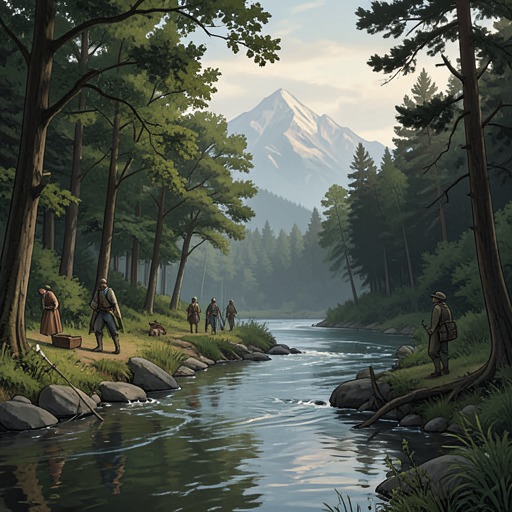
Spring as renewal
Doctor ZhivagoSpring as renewal is not merely a season in Doctor Zhivago but a material force that alters the world before it becomes an idea. Snow melts, waters surge, forests stir, and buds swell on apparently winter-bare branches. Across the journey toward the Urals and later in the countryside around Varykino, renewal arrives through physical changes that make familiar landscapes strange and newly perceptible. The season’s promise is neither abstract nor effortless: it breaks through ice and snow in floods, mud, and disturbance, yet its vivid abundance marks life beginning again.
The thaw along the railway
The journey’s landscape changes abruptly as the train leaves the plains and climbs through mountain country. The north wind gives way to a warm breath from the south, and the track rises and falls through woods on steep slopes. The train labors through them, creaking and puffing as if it were an old forest guard leading its passengers into a world they can only watch. The altered weather announces that the journey has entered a different season and a different kind of landscape.
While Yurii Andreievich sleeps in his bunk, the spring melts the great accumulations of snow that have covered Russia. The thaw reaches back to Moscow, where the family began its journey, and to the snow that passengers and workers spent three days clearing from the line at Ust-Nemdinsk. What had looked like an immense, settled barrier is changing even while the traveler lies still. The contrast between his drowsiness and the landscape’s transformation gives spring a life of its own: outside, the work of renewal continues without waiting for him to witness it.
At first the melting happens inwardly and almost invisibly. Then, once the change is too extensive to remain concealed, water bursts out from beneath the snow. It fills pools, pitches itself down rocks, runs across level ground, and scatters into spray. Snow still obstructs its course, but no longer commands it. The forest wakes in its depths as the earth becomes saturated; water reaches even the ancient pines on high slopes, leaving rusty-white foam around their roots. The image makes renewal both expansive and intimate, a transformation that travels from hidden depths to exposed terrain.
The sky joins this change. Low clouds pass above the woods and release warm rain that smells of soil and sweat, washing the last of the earth’s black covering of ice away. The sensory details refuse to treat spring as a distant emblem: it is heard in rushing water, seen in cloud and rain, and registered as warmth and smell. The thaw’s beauty depends on physical force. Winter does not simply vanish; the new season breaks through what has held the landscape fast.
A spring sensed before it is seen
The transition is also registered in Yurii Andreievich’s half-conscious attention. After a pleasant dream, he wakes briefly while the train is stopped, hears the waterfall again, and drifts back toward sleep. Running feet and a commotion reach him dimly. In the air he senses something new: a faint, sweet, blackish-white presence that he identifies in sleep as wild cherry. The perception belongs to the threshold between waking and dreaming, where spring has not yet become a clear explanation but has already entered the body as scent and atmosphere.
The next morning, the flood makes that change visible through the train window. Water has spread as far as the eye can reach, risen to the embankment, and covered the country around the railway. From the low viewpoint of the bunk, the train seems to glide on the flood. Sunlight runs across the surface in glassy patches; beneath the clouds, fields, hollows, and bushes disappear under water. The scene momentarily blurs the boundary between the solid route of travel and the inundated land beside it. Spring is not a decorative background to the passengers’ movement: it transforms the very ground through which they are moving.
When the train climbs a hill, the flood has begun to withdraw. Fields below the bank are strewn with sand and pieces of timber washed down from higher ground. Above them, a young wood still looks nearly bare. The thaw has not erased winter’s traces; it has rearranged them, leaving evidence of the water’s passage among the trees. The image of renewal is therefore not a clean reset. It bears the marks of upheaval even as it makes new growth possible.
The buds give that upheaval its decisive meaning. Dotted across the bare wood, they appear at first almost out of place, like candle grease or a swelling caused by dirt or inflammation. Yet what seems superfluous or diseased is identified as the sign of life: the most advanced trees are already catching fire with green leaves. A birch’s opening shoots make it seem pierced by barbs and arrows, while its resinous smell can be imagined from its shining surface. The prose delays the easy recognition of spring. It first makes the budding woods look unsettled, then reveals that disturbance as life’s first visible work.
Spring at Varykino
The same seasonal change returns later around Varykino. The household arrives in early spring; soon the alder, nut, and wild-cherry trees turn green, particularly in the Shutma ravine below Mikulitsyn’s house. Then the nightingales begin to sing. The sequence moves from arrival to leafing to birdsong, making renewal a process that unfolds over time rather than a single scenic revelation. Spring alters the place in which the characters live, and its changes become part of the rhythm of their days.
The nightingales’ song prompts a renewed sense of wonder. The narrator dwells on how abruptly their trills leap into richness and individuality, unlike the song of other birds, and recalls Turgenev’s description of their varied, whistling modulations. One phrase is lavish and insistently repeated; another sounds solemn and imploring, like an appeal or warning: “Wake up! Wake up!” The call makes the season seem to address its listeners, but the passage does not reduce birdsong to a simple message. Its power lies in the sudden variety and force of living sound, which can be heard anew even by someone who already knows it.
The diary’s changing relation to the season gives that awakening a practical counterpoint. The writer first records spring’s arrival in an impressionistic fragment: thaw, the smell of Shrovetide pancakes and vodka, a sleepy sun, pines blinking their needles, and puddles shining at noon. The countryside seems to yawn, stretch, turn over, and fall asleep again. Spring here is not uninterrupted vitality; it has the languor and reversals of a body waking, with motion alternating with rest.
Later, the diary notes that spring sowing is being prepared and that there is no time to write. The pause is consequential: seasonal renewal draws attention away from the act of recording it and into work tied to the land. The writer expects to resume only in the next winter. Thus the movement from sensory observation to the demands of sowing gives the season two distinct registers. It is an experience to be contemplated and a change of conditions that reorganizes daily labor.
Renewal as a form of perception
Across these scenes, spring is described through transformations that resist a settled, schematic view of nature. Snow’s secret melting becomes a roar; a bare tree’s apparent inflammation becomes the promise of leaves; a bird’s song opens into unexpected richness. In each case, perception must be revised. The prose lingers over water, scent, buds, and sound so that renewal is not passed over as a familiar seasonal convention but encountered as a change whose meaning emerges from its details.
Spring also joins apparently separate moments in the novel. The train’s passage through mountain woods and floodwater makes the season a force acting across a vast landscape; Varykino’s green trees and nightingales bring that force close to habitation, listening, and work. In both settings, life returns through disturbance: water overflows its banks, the earth is saturated, buds swell where winter had left bare branches, and the quiet of the countryside gives way to song. Renewal is not the restoration of an untouched world. It is life’s capacity to emerge through altered, even damaged, ground.
The motif’s force finally rests in the difference between dormancy and extinction. The landscape can appear asleep, snowbound, or stripped of leaves, but signs of change are already gathering beneath its surface. Spring makes those signs audible and visible, and it changes what characters can perceive and do: a sleeper catches the scent of wild cherry, a traveler sees the railway suspended within a flood, and a household turns from its diary toward sowing. The season’s renewal is therefore at once natural process, sensory awakening, and renewed participation in life.